
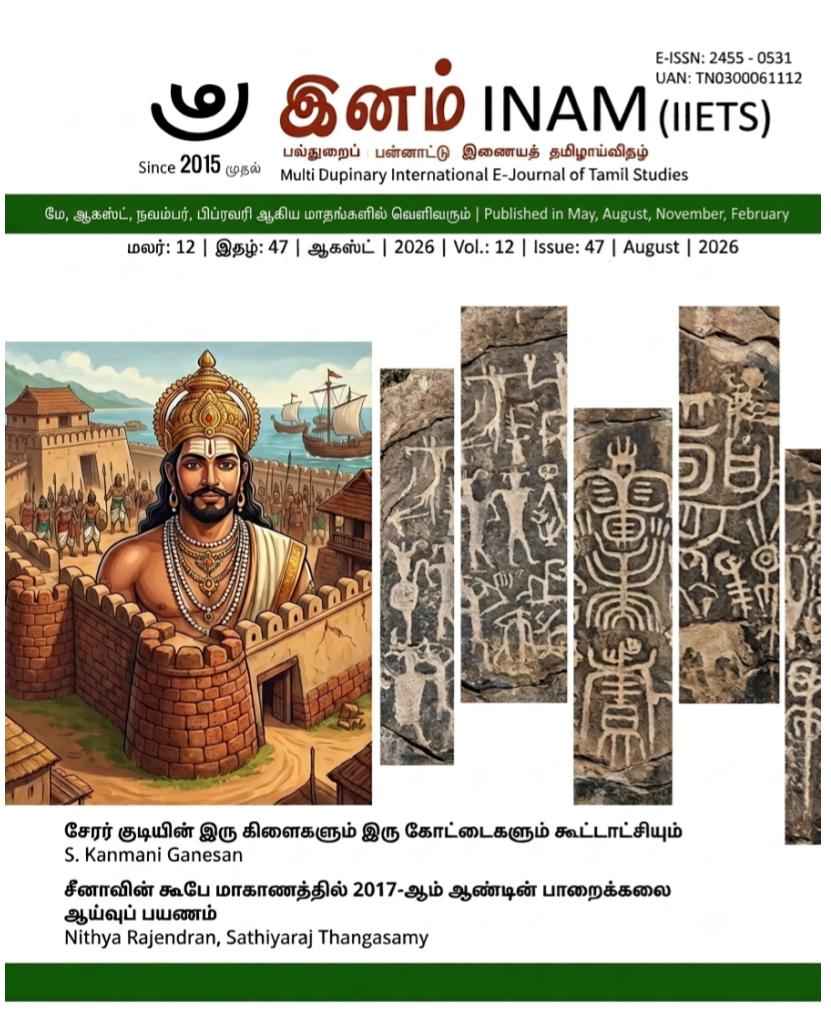
Dual Branches, Forts and Coalition Government of the Chera Clan
Keywords:
சேரர், பதிற்றுப்பத்து, நாலுவஞ்சி, வஞ்சிநகர், செப்பேடுகள், கல்வெட்டுகள், சேரர் ஆட்சிமுறை, சங்ககால வரலாறுAbstract
This study investigates the distinctive political characteristics of the Chera polity during the Sangam anthology period by tracing the early historical significance and textual continuity of the expressions “Karupathi Pala,” “Naalu Vanji,” and “Vanjinakar Naalum” recorded in copper-plate inscriptions. Particular attention is given to the political relationship between the two branches of the Chera lineage represented in the Pathirruppaththu, with a view to clarifying their respective periods of rule, territorial extent, fortifications, capital cities and their variant names, and systems of governance.
The Pathirruppaththu constitutes the primary textual source for the study, while other Sangam anthologies, the Cilappatikāram, traditional commentaries, modern scholarly interpretations, dictionaries, inscriptions, copper-plate records, and archaeological excavation reports are employed as supporting sources. The study adopts a historical and comparative approach, integrating close textual analysis with epigraphic and archaeological evidence to examine the political geography and institutional structures of the Chera polity.
The findings suggest that Chera political organization during this period cannot be adequately understood solely through the conventional model of monarchical succession. Rather, the evidence points towards a form of co-rulership or power-sharing among members of two branches of the Chera royal lineage, reflecting a distinctive mode of political organization. This interpretation contributes to a more nuanced understanding of Chera state formation, territorial administration, dynastic relationships, and the shifting identities of their political centres. By correlating literary, epigraphic, and archaeological evidence, the study offers a historically grounded reassessment of the political structure and distinctive features of the Chera polity during the Sangam period.
References
Ainkurunooru. (2009). Chennai: Kazhaka Veliyeedu.
Akanaanooru: Manimidai Pavalam. (2007). Chennai: Kazhaka Veliyeedu.
Akanaanooru: Niththilakkovai. (2008). Chennai: Kazhaka Veliyeedu.
Aravindan Neelakandan. (2021, March 5). “Dr. R. Krishnamurthy (1933–2021): A Life in Quest of Ancient Scripts and Coins.” Swarajya.
Cilapathikaaram. (1975). Chennai: Kazhaka Veliyeedu.
Govinthan, Kaa. (1955). Changakaala Arasar Varisai. Chennai: Kazhaka Veliyeedu.
Kazhagath Thamizhakarathi. (1974). Chennai: Kazhaka Veliyeedu.
Kanakasabai, V. (1952). Aayiraththu Ennuuru Aandukatku Murpatta Thamizhakam. Translated by Appaaththurai, Kaa. Chennai: Kazhaka Veliyeedu.
Kaasinaathan, Nadana, & Daamodharan, Ku. (1973). Kalvettu – Or Arimukam. Chennai: Department of Archaeology, Government of Tamil Nadu.
Krishnasaamy Aiyangaar, S. (1946). Cheran Vanji. Chennai: Educational Publishing Company.
Kunjan Pillai, Elangulam. (1970). Studies in Kerala History. Kottayam: National Book Stall.
Kurunthokai. (2007). Chennai: Kazhaka Veliyeedu.
Paramasivaanantham, A. Mu. (1972). Thamizhaka Varalaaru. Chennai: Thamizhkkalai Pathippakam.
Pasuvalingam, Ma. (1984). Changakaala Vanji. Chennai: Sekar Pathippakam.
Paththuppaattu, Part I. (2007). Chennai: Kazhaka Veliyeedu.
Pathirruppaththu. (2007). Chennai: Kazhaka Veliyeedu.
Pattanam and the Excavations – Muziris Heritage – Spice Route: Rediscover the Spice Route. Kerala Tourism and UNESCO Project in Muziris.
Puranaanooru, Part I. (2007). Chennai: Kazhaka Veliyeedu.
Raakavaiyangaar, Mu. (1964). Aaraaychchith Thokuthi. Chennai: Paari Nilaiyam.
Raakavaiyangaar, Mu. (1947). Cheran Chenguttuvan. Trichi: Pazhaniyappaa Brothers.
Raakavaiyangaar, R. (1917). Vanjimaanagar. Madurai: Thamizhchchanga Muththiraasaalai.
Raamalingan, Pe. (1977). Karuvuure Vanji. Chennai: Asokan Pathippakam.
Sathasiva Pandaraththaar. (1977, December). Ilakkiyamum Kalvettukalum. Chennai: Manivasakar Nuulakam.
Subramanya Aiyar, K. V. (1937). South Indian Inscriptions, Vol. VIII. Delhi: Manager of Publications.
Downloads
Published
Issue
Section
License
Copyright (c) 2026 இனம்: பல்துறைப் பன்னாட்டு இணையத் தமிழாய்விதழ் (Inam: Multidisciplinary International E-Journal of Tamil Studies)

This work is licensed under a Creative Commons Attribution-NonCommercial-NoDerivatives 4.0 International License.